
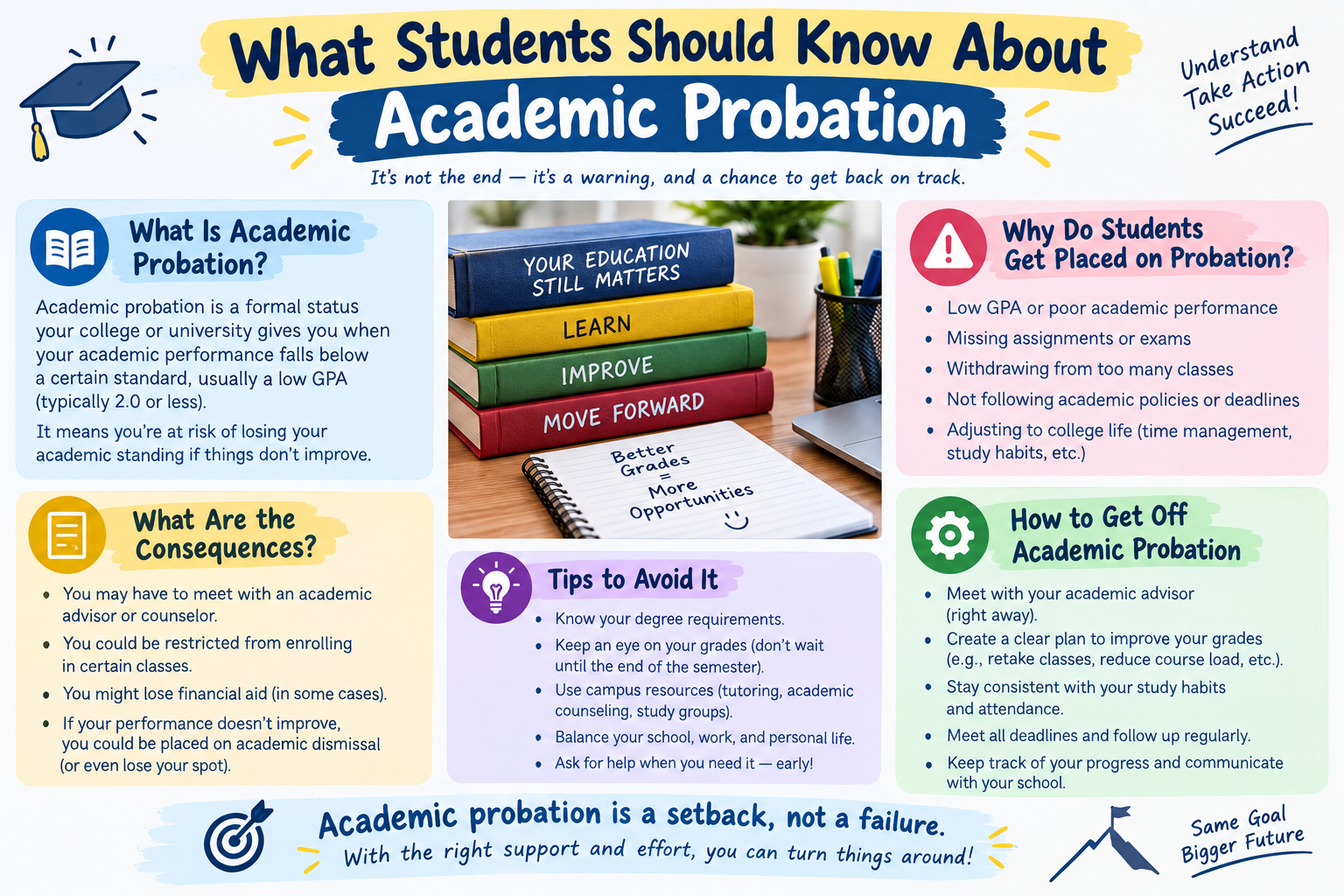
College students can face many academic challenges during their degree programs. Difficult courses, personal responsibilities, poor time management, or an unexpected change in circumstances can sometimes lead to lower grades. When a student’s academic performance falls below the standards set by a college or university, the student may be placed on academic probation. Study’s Point provides educational information and practical resources to help students better understand college life, academic requirements, and strategies for improving their studies. Understanding academic probation early can help students recognize what it means, what they should do next, and how they can work toward returning to good academic standing.
What Is Academic Probation?
Academic probation is a status that a college or university may assign to a student whose academic performance falls below the institution’s required standards.
Colleges commonly use measures such as:
- Grade point average (GPA)
- Completion of required credits
- Academic progress
- Course completion rates
The exact requirements vary from one college to another.
Being placed on probation does not necessarily mean that a student has been dismissed from college. It is generally a warning that the student’s academic performance needs improvement.
Students should check their institution’s official academic policies because probation rules can be different between schools and programs.
Why Do Students Get Placed on Academic Probation?
One common reason is a GPA that falls below the college’s minimum requirement.
For example, a college may require students to maintain a certain cumulative GPA. If a student’s GPA falls below that standard, the college may place the student on probation.
Other factors may also be involved.
These can include:
- Failing several courses
- Withdrawing from too many classes
- Not completing enough credits
- Failing to meet program requirements
- Poor academic progress
- Falling below a required GPA for a particular major
The specific reason should normally be explained in the student’s academic notice or college policy.
What Is GPA?
GPA stands for Grade Point Average.
It is a numerical representation of a student’s academic performance based on grades earned in courses.
Different colleges may use different grading systems, but a common U.S. grading scale uses a 4.0 system.
For example:
- A = approximately 4.0
- B = approximately 3.0
- C = approximately 2.0
- D = approximately 1.0
- F = approximately 0.0
The actual calculation can depend on the institution and course.
A student’s GPA can be calculated for one semester or across multiple semesters.
What Is Good Academic Standing?
A student is generally considered to be in good academic standing when they meet the institution’s academic requirements.
These requirements may include:
- Minimum GPA
- Minimum credit completion
- Satisfactory academic progress
- Required grades in major courses
If a student falls below one or more standards, the college may assign a different academic status, such as probation.
Because policies vary, students should review their school’s definition of good academic standing.
Academic Probation vs. Academic Suspension
Academic probation and academic suspension are not necessarily the same thing.
Academic probation generally means the student is still allowed to continue studying but must improve academic performance.
Academic suspension can mean that a student is temporarily not permitted to enroll.
The exact definitions and procedures vary by institution.
Students should not assume that probation automatically leads to suspension. Instead, they should find out what standards apply at their specific college.
Is Academic Probation the Same as Academic Dismissal?
No.
Academic dismissal is generally a more serious academic status in which a college may require a student to leave the institution.
Probation usually provides the student with an opportunity to improve before more serious consequences occur.
However, a student who remains below the required academic standards may face additional action according to the college’s policies.
This is why students should take probation notices seriously and respond as soon as possible.
How Long Does Academic Probation Last?
The length of probation depends on the college.
Some institutions review academic status at the end of each semester.
A student may remain on probation until their GPA or other academic requirements improve.
For example, a student may be required to complete the next semester with a minimum GPA.
Other colleges may use different standards.
Always check your school’s official academic calendar, student handbook, or academic policy.
What Happens During Academic Probation?
The experience can vary from one college to another.
A student may be required to:
- Meet with an academic advisor
- Create an academic improvement plan
- Complete specific courses
- Maintain a minimum semester GPA
- Limit the number of credits taken
- Attend academic support sessions
- Participate in tutoring
- Meet regularly with an advisor
Some colleges may have no additional requirements beyond maintaining academic standards.
Read Your Probation Notice Carefully
If you receive an academic probation notice, read it carefully.
Look for information about:
- Why you were placed on probation
- Required GPA
- Required courses
- Deadlines
- Advising requirements
- Appeal procedures
- Conditions for returning to good standing
- Consequences if requirements are not met
Do not ignore official college messages.
If something is unclear, contact your academic advisor or the appropriate college office.
Talk to an Academic Advisor
One of the most useful steps is to meet with an academic advisor.
An advisor can help you understand your academic record and identify possible ways to improve.
During the meeting, you can ask:
- What caused my probation status?
- What GPA do I need?
- Which courses should I take next?
- Should I reduce my course load?
- Can I retake a course?
- What academic resources are available?
- What happens if I do not meet the required standard?
Bring your academic information and probation notice to the meeting.
Identify the Cause of the Problem
Improving your academic performance starts with understanding what went wrong.
Ask yourself honestly:
Did I miss classes?
Did I submit assignments late?
Did I take too many courses?
Did I struggle with one particular subject?
Did I work too many hours?
Did I have difficulty managing my time?
Did personal circumstances affect my studies?
Did I wait too long before asking for help?
The answer may involve more than one factor.
Create an Academic Improvement Plan
After identifying the problem, create a realistic plan.
Your plan might include:
- Attending every class
- Completing assignments earlier
- Studying at scheduled times
- Meeting with professors
- Using tutoring services
- Reducing unnecessary commitments
- Reviewing notes regularly
- Preparing for exams earlier
A clear academic improvement plan can turn a general goal such as “get better grades” into specific actions.
Improve Your Time Management
Poor time management is a common academic challenge.
Create a weekly schedule that includes:
- Classes
- Study sessions
- Assignments
- Work
- Meals
- Sleep
- Personal responsibilities
Break large assignments into smaller tasks.
For example:
Instead of scheduling “write research paper,” schedule:
- Choose topic
- Find sources
- Create outline
- Write introduction
- Draft body sections
- Revise
- Proofread
This makes large tasks more manageable.
Use Academic Support Services
Many colleges offer resources that can help students improve their performance.
These may include:
- Tutoring
- Writing centers
- Math labs
- Academic coaching
- Study groups
- Library support
- Supplemental instruction
Using these resources can be especially helpful when a student is struggling in a specific course.
Communicate With Your Professors
If you are struggling in a class, do not wait until the end of the semester.
Ask your professor for clarification when you do not understand something.
You can ask about:
- Difficult concepts
- Assignment expectations
- Practice resources
- Exam preparation
- Feedback on your work
Professor office hours can be a useful opportunity to get additional academic support.
Consider Your Course Load
Sometimes students take more courses than they can realistically manage.
If you are working, caring for family members, commuting long distances, or dealing with other responsibilities, a very heavy course load may be difficult.
Before changing your schedule, speak with an academic advisor.
They can explain how reducing or changing your course load could affect your degree progress, financial aid, enrollment status, or other requirements.
Retaking a Course
Some colleges allow students to retake courses in which they received poor grades.
However, policies vary.
A repeated course may affect your GPA and degree credits differently depending on the school’s rules.
Before retaking a course, ask:
- Will the new grade replace the old grade?
- Will both grades remain on the transcript?
- Will the course count toward graduation?
- Are there limits on course repeats?
- Will financial aid be affected?
Get clear information from your institution before making a decision.
What About Financial Aid?
Academic performance can sometimes affect financial aid eligibility.
Many U.S. institutions and financial aid programs have Satisfactory Academic Progress (SAP) requirements.
These requirements may consider factors such as:
- GPA
- Pace of completing coursework
- Maximum time allowed to complete a degree
A student on academic probation should check whether their academic status affects financial aid.
Because financial aid rules vary by program and institution, speak with your college’s financial aid office for information specific to your situation.
Can You Appeal Academic Probation?
Whether a student can appeal an academic decision depends on the institution.
Some colleges have appeal procedures for students who experienced significant circumstances affecting their academic performance.
Possible circumstances may include:
- Serious family responsibilities
- Unexpected personal events
- Other documented circumstances recognized by the institution
The college may require documentation and a written explanation.
Students should carefully follow the official appeal process and deadlines.
Do Not Ignore the Situation
Ignoring academic probation can make the situation more difficult.
Avoid assuming that the problem will automatically disappear after another semester.
Instead:
- Read the official notice.
- Understand the requirements.
- Meet with an advisor.
- Identify academic challenges.
- Create a realistic plan.
- Use available support.
- Monitor your grades throughout the semester.
Taking action early gives you more time to make adjustments.
Track Your Grades During the Semester
Do not wait until final grades are posted to find out how you are performing.
Keep track of:
- Assignment grades
- Quiz grades
- Exam scores
- Attendance
- Missing assignments
- Overall course progress
If you notice that your performance is falling, seek help early.
A small problem can sometimes be easier to address before it becomes a major academic issue.
Take Care of Your Basic Needs
Academic performance can be affected by daily habits.
Try to maintain a reasonable routine that includes:
- Enough sleep
- Regular meals
- Study time
- Breaks
- Physical activity
- Personal time
This does not guarantee higher grades, but a balanced routine can make it easier to manage academic responsibilities.
Do Not Let Probation Define You
Academic probation is an academic status. It is not a complete description of a student’s abilities or future.
A difficult semester can happen for many reasons.
What matters academically is understanding the situation and taking appropriate steps to improve.
Use the experience as an opportunity to identify problems in your study routine, course planning, or time management.
Common Mistakes to Avoid
Students on probation should try to avoid:
- Ignoring college emails
- Missing advisor appointments
- Taking an unrealistic course load
- Waiting until finals to ask for help
- Skipping classes
- Repeating the same study habits that caused problems
- Assuming probation rules are the same at every college
- Ignoring financial aid requirements
Small changes can make a meaningful difference over time.
A Simple Recovery Plan
Here is an example of a basic academic recovery strategy:
Week 1
Meet with your advisor and understand your academic requirements.
Week 2
Create a realistic weekly study schedule.
Week 3
Begin using tutoring or other academic support.
Week 4
Review your grades and identify difficult courses.
Throughout the Semester
Attend classes, complete assignments on time, study consistently, and communicate with professors when needed.
End of Semester
Review your academic progress and determine whether you have met the requirements to return to good academic standing.
Your college may have different procedures, so use this only as a general framework.
Final Thoughts
Academic probation can be a stressful experience, but it is important to understand exactly what the status means at your college. Probation usually indicates that a student’s academic performance has fallen below an institutional standard, but the specific requirements and consequences vary between schools.
If you receive a probation notice, start by reading it carefully and contacting your academic advisor. Identify the reasons behind your academic difficulties, create a realistic improvement plan, and use resources such as tutoring, writing centers, study groups, and professor office hours.
Most importantly, do not ignore the situation. Monitor your grades, manage your time carefully, and make adjustments when something is not working. With a clear understanding of your college’s policies and a consistent effort to improve, you can work toward meeting the academic standards required by your institution.
Disclaimer
The information provided by Study’s Point is intended for general educational and informational purposes only. Academic probation policies, GPA requirements, suspension rules, appeal procedures, financial aid requirements, and graduation standards vary by college and program. Students should review their institution’s official policies and consult appropriate college officials for guidance about their individual academic situation.
Terms & Conditions
By using Study’s Point, you agree to use the information provided on this website for lawful and informational purposes. Content may be updated or changed without prior notice. Study’s Point does not guarantee specific academic, educational, financial, career, or other outcomes from using information available on the website.
Privacy Notice
Study’s Point respects visitor privacy. Information collected through the website is handled according to applicable privacy practices. Visitors should review the Privacy Notice for additional information about data collection, cookies, advertising technologies, and website usage.
Contact Study’s Point
For questions, suggestions, or general inquiries, contact Study’s Point at support@studyspoint.com.
About Study’s Point
Study’s Point is an educational website providing study materials, academic information, and practical resources for students. Our goal is to make useful educational information easier to understand and apply in everyday student life.