
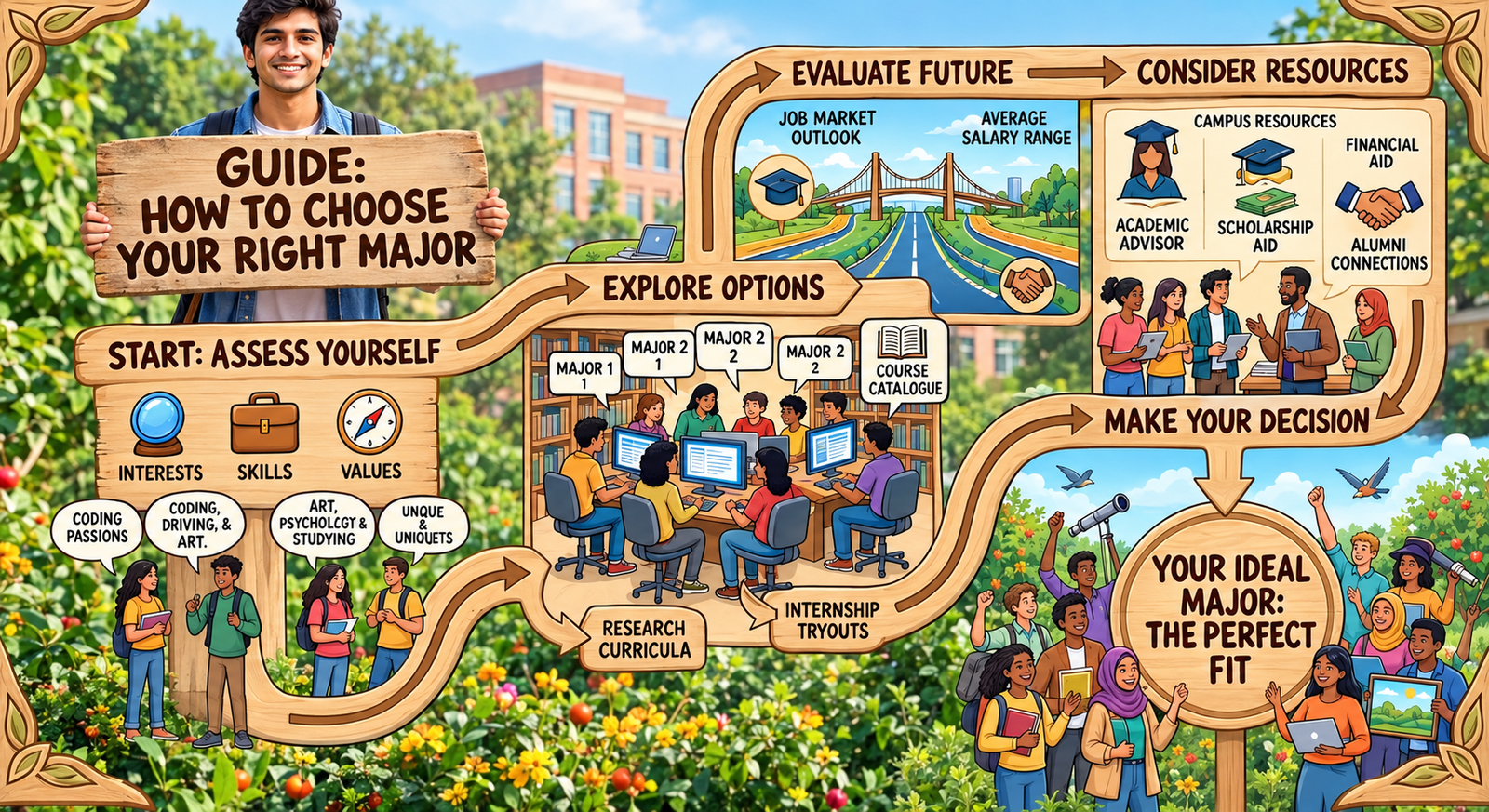
Choosing a college major is one of the biggest academic decisions many students make. It can influence the courses they take, the skills they develop, and the types of careers they may explore after graduation. However, choosing a major does not mean that you have to know exactly what you will do for the rest of your life. Study’s Point provides useful study material and practical information to help students understand college life and make informed academic decisions. When choosing a major, it is helpful to consider your interests, strengths, goals, academic requirements, and the opportunities available through different programs.
There is no single major that is perfect for every student. The right choice depends on your individual circumstances and what you want from your college education.
Understand What a College Major Is
A college major is the primary area of study that a student chooses as part of a degree program.
For example, a student might major in:
- Business
- Computer Science
- Biology
- Psychology
- Economics
- Education
- Engineering
- Communications
- History
- Political Science
The major usually determines a significant portion of the courses a student takes.
However, a major does not necessarily determine one specific career.
A student who studies English, for example, may eventually work in education, communications, publishing, marketing, writing, or other areas.
Understanding this can reduce some of the pressure students feel when choosing a major.
Start With Your Interests
One useful place to begin is by thinking about the subjects you genuinely enjoy.
Ask yourself:
- Which classes do I look forward to?
- What topics do I enjoy learning about?
- What subjects make me curious?
- What type of work do I enjoy doing?
- Which assignments do I usually find interesting?
Your interests do not automatically determine your major, but they can provide useful clues.
If you enjoy understanding how businesses operate, you might explore business or economics.
If you enjoy solving technical problems, computer science or engineering may be worth researching.
If you enjoy understanding people and behavior, psychology or sociology could be areas to explore.
The goal is not to choose a major immediately. Start by creating a list of areas that interest you.
Consider Your Strengths
Your academic strengths are another factor to consider when choosing a college major.
Think about subjects where you consistently perform well.
For example, you might be strong in:
- Mathematics
- Writing
- Research
- Science
- Public speaking
- Technology
- Creative work
- Organization
- Problem-solving
Being good at a subject does not mean you have to major in it.
However, your strengths can help you identify programs where you may feel comfortable developing more advanced skills.
Also remember that a challenging subject is not automatically the wrong choice. If you are interested in an area but currently lack some skills, you may be able to improve with practice and support.
Research Different Majors
Do not choose a major based only on its name.
Research what students actually study in the program.
Look at the course requirements, electives, projects, and other academic expectations.
For example, two majors might sound similar but have very different coursework.
When researching a program, look for information about:
- Required courses
- Elective options
- Prerequisites
- Typical assignments
- Projects
- Internship opportunities
- Graduation requirements
- Related programs
The more you understand about a major, the easier it becomes to decide whether the program matches your interests and goals.
Review the Curriculum
The curriculum can tell you a lot about what your college experience may look like.
Visit the official college or university website and review the program requirements.
Look at the courses you would likely take during your first year, middle years, and final year.
Ask yourself:
“Would I enjoy studying these subjects?”
“Can I handle the expected workload?”
“Do these courses help me develop skills I want?”
“Are there electives that interest me?”
A program may sound exciting until you look at the actual course list. Researching the curriculum before making a decision can help you avoid surprises.
Think About Your Career Interests
Career goals can be useful when selecting a major, but they should not be the only factor.
Some careers require specific educational paths or credentials. Others may accept graduates from several different majors.
For example, certain professional fields may have specific education requirements, while other employers may focus more heavily on skills, experience, internships, and communication abilities.
Research the educational requirements for careers that interest you.
If a particular career requires a specific degree or professional qualification, understand that requirement before choosing your program.
Do Not Choose a Major Only Because of Salary
Income can be an important consideration when thinking about your future, but choosing a major only because someone says it pays well can create problems.
A field may have strong earning potential but involve subjects or work that you do not enjoy.
On the other hand, a field that interests you may provide opportunities you had not considered.
When looking at career options for college majors, consider several factors rather than focusing on one number.
These can include:
- Job responsibilities
- Education requirements
- Work environment
- Career growth
- Location
- Skills required
- Personal interests
- Employment opportunities
Career and salary information can also change over time, so use current and reliable sources when researching.
Talk to People in Different Fields
Sometimes the best way to understand a major is to talk to someone who has studied or worked in that area.
You could speak with:
- Professors
- Academic advisors
- Current students
- Recent graduates
- Professionals
- Career counselors
Ask practical questions.
“What do you actually study in this major?”
“What kinds of assignments do students complete?”
“What skills are important?”
“What types of jobs do graduates pursue?”
“What do you wish you had known before choosing this field?”
Different people will have different experiences, so do not base your entire decision on one person’s opinion.
Consider Job Shadowing and Internships
If you have an opportunity to gain practical experience, take advantage of it.
An internship, volunteer position, part-time job, or job-shadowing experience can help you understand what a field is actually like.
For example, a student interested in healthcare might discover that they enjoy patient interaction but do not enjoy a particular work environment.
Another student interested in technology might learn that they prefer project management over programming.
Real-world experience can provide information that you cannot always get from a course description.
Think About the Skills You Want to Develop
A major is not only about the subject you study. It is also about the skills you develop.
Depending on the program, you might develop skills such as:
- Writing
- Research
- Data analysis
- Communication
- Programming
- Critical thinking
- Problem-solving
- Teamwork
- Project management
- Presentation skills
When comparing choosing a college major options, think about which skills you want to have when you graduate.
Transferable skills can be useful in many different careers.
Consider Your Learning Style
Different programs may involve different types of learning.
Some majors include a lot of reading and writing.
Others may involve laboratories, calculations, programming, design projects, presentations, or practical work.
Think about the type of academic work you prefer.
Do you enjoy:
- Reading and writing?
- Solving problems?
- Working with numbers?
- Conducting experiments?
- Building things?
- Creating visual projects?
- Working with people?
- Working independently?
Your preferred learning activities can help you identify programs worth exploring.
Think About the Cost and Time
Education involves financial and time commitments.
Before choosing a program, understand the expected length of the degree and the costs associated with attending your institution.
Depending on the major, students may need additional education after completing a bachelor’s degree.
For example, some professional careers may require graduate education, certifications, licenses, or other qualifications.
This does not mean you should avoid those careers. It simply means you should understand the full educational path before making a decision.
Do Not Let Friends Choose for You
Friends can provide useful advice, but they should not make your academic decision for you.
Your friend may love a particular major because it matches their interests and goals.
That does not mean it will be the right choice for you.
Similarly, you do not have to choose the same major as your friends simply because you want to stay together.
College is a personal educational journey.
Consider other people’s experiences, but make your own decision based on your goals and circumstances.
Do Not Choose a Major Just to Please Someone Else
Parents, relatives, teachers, and friends may have strong opinions about what you should study.
Their advice may come from good intentions.
However, you will be the person taking the courses and developing the skills.
If you feel pressured to choose a field you do not want, take time to understand why.
Listen to advice, ask questions, and research the available options.
Your major selection guide should ultimately help you make an informed personal decision rather than simply following someone else’s preference.
Take an Interest or Career Assessment
Some colleges provide career assessments or interest inventories.
These tools can help you identify subjects, work activities, or career areas that match your interests.
They should be treated as one source of information rather than a final answer.
An assessment might suggest several areas you had not previously considered.
Use those suggestions as starting points for further research.
What If You Are Undecided?
Being undecided is normal.
You do not necessarily need to have your entire future planned before starting college.
If you are unsure, use your first semesters to explore.
Take appropriate introductory courses.
Attend academic events.
Talk to professors.
Visit career services.
Research different departments.
Keep track of subjects you enjoy and subjects you do not.
Exploring can help you make a more informed decision later.
Can You Change Your Major?
In many colleges, students can change their major, although the rules vary.
Changing majors may affect your course plan, credits, graduation timeline, and costs.
If you are considering a change, speak with an academic advisor and review the official requirements of the new program.
Do not assume that changing majors will automatically delay graduation, but also do not assume that it will have no effect.
Understand the details before making the change.
Create a Shortlist
If you have several possible majors, create a shortlist.
For example:
- Business
- Computer Science
- Economics
- Communications
Then compare them.
You might create categories such as:
- Interest
- Strengths
- Course requirements
- Career possibilities
- Skills developed
- Cost and time
- Opportunities for practical experience
This does not mean assigning a score to your future. It simply helps you organize the information you have collected.
Make a Decision Based on Multiple Factors
There is rarely one single factor that can tell you which major to choose.
Instead, look at the complete picture.
Consider your interests, strengths, academic expectations, career possibilities, educational requirements, personal circumstances, and long-term goals.
You may not find a major that checks every box.
That is okay.
The goal is to find an option that makes sense based on the information available to you.
Final Thoughts
Choosing the right college major can feel like a huge decision, but you do not need to know every detail about your future before making your choice.
Start by understanding your interests and strengths. Research different programs and examine their actual course requirements. Consider possible careers and the skills you want to develop. Talk to advisors, professors, students, and professionals. Look for opportunities to gain practical experience.
If you are undecided, give yourself permission to explore.
A major is an important part of your college education, but it does not necessarily define your entire professional life. People can develop new interests, gain additional qualifications, change career directions, and use transferable skills in unexpected ways.
The most useful approach to how to choose a college major is to gather reliable information, understand your own goals, and make a thoughtful decision based on your circumstances.
Disclaimer
The information provided in this article is for general educational and informational purposes only. It is not professional academic, financial, insurance, legal, medical, or career advice. College programs, admission requirements, career requirements, costs, and employment conditions can vary and may change over time.
Students should verify important information with their college, university, academic department, career services office, or another appropriate official source before making significant academic or career decisions.
Terms and Conditions
By using Study’s Point, visitors agree to use the website for lawful and personal informational purposes. Content published on the website is provided for general information and may be updated, changed, or removed without prior notice.
Study’s Point does not guarantee that every article will always be complete, current, or suitable for every individual’s circumstances. Website content should not be treated as a replacement for official college information or professional advice.
Visitors must not use the website for unlawful purposes, attempt to interfere with its operation, or reproduce substantial amounts of website content without appropriate permission.
Privacy Notice
Study’s Point may use cookies, analytics tools, and advertising technologies to understand website traffic, improve website performance, and support website operations.
Third-party advertising and analytics providers may have their own privacy policies and terms. Visitors should review those policies when applicable.
Study’s Point does not require readers to provide unnecessary personal information when accessing educational content.
Contact
For questions, suggestions, corrections, or concerns regarding content published on Study’s Point, visitors can contact the website through its official contact channel.
Email: support@studyspoint.com
About Study’s Point
Study’s Point is an educational and informational website providing useful study material and practical information for students. The website focuses on clear and accessible content covering academic topics, study techniques, college preparation, and other useful educational subjects.
The information provided on Study’s Point is intended for general informational purposes and does not replace advice from qualified educators, academic advisors, career counselors, college officials, or other professionals.