
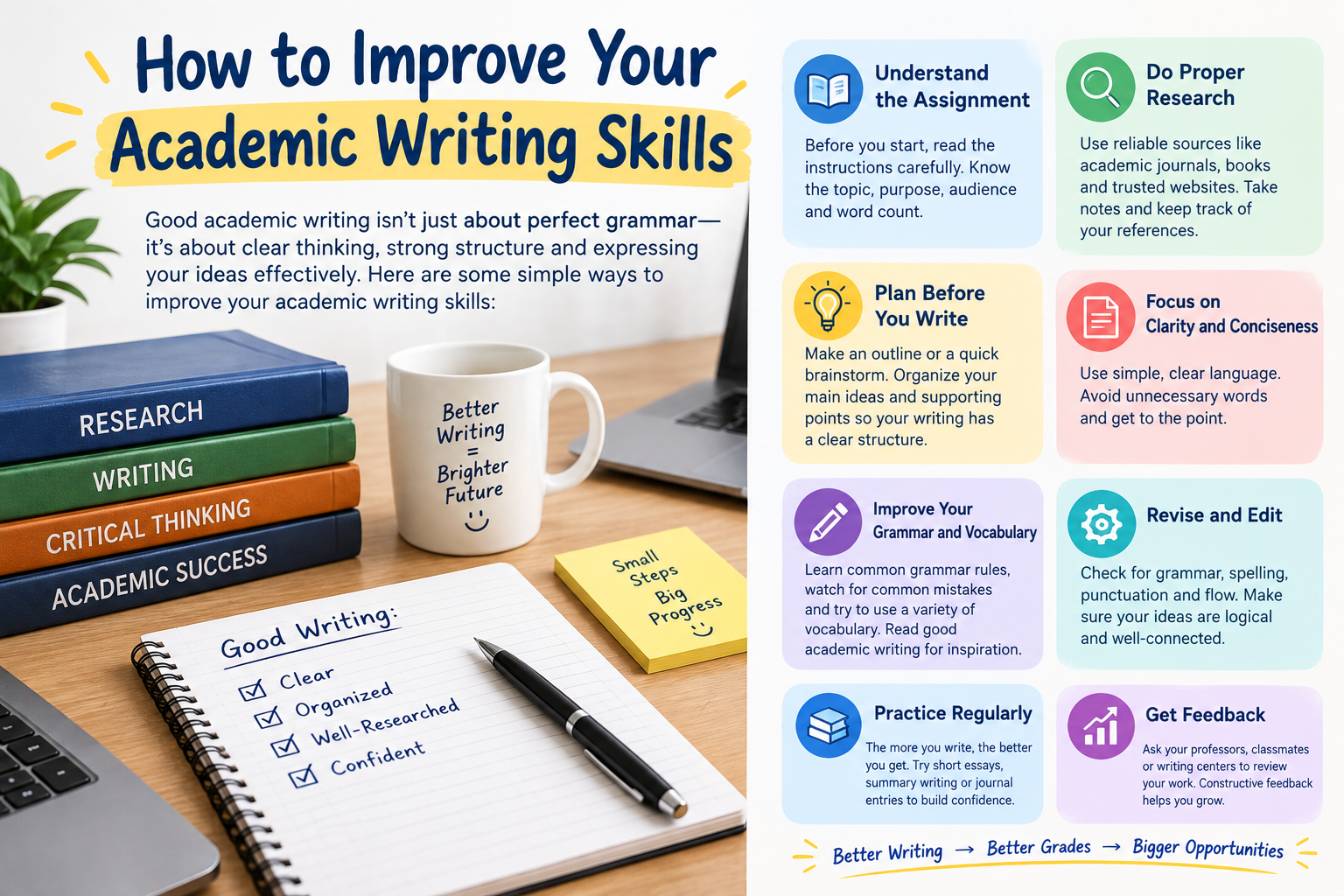
Writing is an important part of college life. Students may be asked to write essays, research papers, discussion posts, reports, summaries, and other academic assignments. Strong writing skills can help students communicate their ideas clearly and present information in an organized way. Study’s Point provides practical educational resources to help students develop better study and academic skills. Improving academic writing does not happen overnight, but regular practice, careful reading, and learning from feedback can make a significant difference over time.
What Is Academic Writing?
Academic writing is writing that is used in educational settings to explain ideas, present information, analyze topics, or support an argument.
College writing is usually different from casual writing because it requires more organization, clarity, evidence, and attention to language.
Examples include:
- College essays
- Research papers
- Lab reports
- Literature reviews
- Analytical papers
- Case studies
- Discussion posts
- Academic reports
The exact style depends on the assignment and subject.
Understand the Assignment First
One of the most important academic writing skills is understanding what the assignment actually asks you to do.
Before writing, carefully read the instructions.
Look for words such as:
- Analyze
- Compare
- Explain
- Describe
- Evaluate
- Discuss
- Summarize
- Argue
These words tell you what type of response your professor expects.
For example, “describe” usually asks you to explain something, while “analyze” requires you to examine the topic more deeply.
If you misunderstand the assignment, even a well-written paper may not fully answer the question.
Choose a Clear Topic
If you are allowed to choose your own topic, select something that is specific enough to discuss within the required word count.
A topic that is too broad can make your paper unfocused.
For example:
“Technology”
is extremely broad.
A more specific topic could be:
“How Online Learning Technology Affects College Student Engagement.”
A focused topic makes it easier to decide what information belongs in your paper and what information should be left out.
Create a Clear Thesis Statement
A thesis statement tells the reader the main point or central argument of your paper.
A strong thesis helps guide the entire assignment.
For example:
“Regular use of digital study tools can improve college students’ organization, but students must manage distractions to use these tools effectively.”
This statement gives the reader a clear idea of what the paper will discuss.
Your thesis may change as you research and develop your ideas. That is normal.
Make an Outline Before Writing
Creating an outline can make the writing process much easier.
A basic college paper might include:
Introduction
- Background information
- Topic
- Thesis statement
Body Paragraph 1
- Main idea
- Evidence
- Explanation
Body Paragraph 2
- Main idea
- Evidence
- Explanation
Body Paragraph 3
- Main idea
- Evidence
- Explanation
Conclusion
- Main points
- Final perspective
An outline prevents your ideas from becoming disorganized.
Write a Strong Introduction
The introduction should give the reader enough information to understand the topic.
A good introduction often moves from general information toward the specific subject of the paper.
It can include:
- Background information
- Context
- The main issue
- Thesis statement
Avoid making the introduction unnecessarily long.
The goal is to prepare the reader for the discussion that follows.
Focus on One Main Idea Per Paragraph
Each body paragraph should generally focus on one main idea.
Start with a clear topic sentence.
For example:
“Time management can help college students complete writing assignments more efficiently.”
Then explain the idea, provide supporting information, and connect it back to your overall argument.
This structure improves writing organization and makes the paper easier to follow.
Use Evidence Effectively
Academic writing often requires evidence to support important statements.
Evidence may include:
- Research findings
- Statistics
- Academic sources
- Examples
- Historical information
- Expert statements
- Data
However, simply adding a source does not automatically make an argument strong.
You should explain why the evidence matters and how it supports your point.
Explain Your Evidence
One common problem in student writing is presenting evidence without explaining it.
For example, a student may provide a statistic and immediately move to the next paragraph.
Instead, explain what the statistic shows.
Ask yourself:
“What does this evidence mean?”
“How does it support my argument?”
“Why should the reader care?”
This additional explanation demonstrates critical thinking in writing.
Use Your Own Words
When reading sources, students should understand the information before trying to write about it.
Avoid copying sentences and simply changing a few words.
Instead, read the information, understand the idea, and explain it in your own words.
If you use someone else’s exact wording, quotation marks and appropriate citation are generally required.
Learn How to Paraphrase
Paraphrasing means expressing information from a source in your own words while keeping the original meaning.
Good paraphrasing is more than replacing a few words with synonyms.
A useful approach is:
- Read the original information carefully.
- Understand its meaning.
- Look away from the source.
- Write the idea in your own words.
- Compare your version with the original.
- Add the appropriate citation.
This can improve both your writing and your understanding of the material.
Improve Sentence Structure
Strong academic writing does not require complicated sentences.
Clear sentences are usually easier to understand.
Instead of creating very long sentences with several ideas, consider separating them.
For example:
“Students often struggle with academic writing because they may have difficulty organizing their ideas, understanding assignment requirements, finding reliable evidence, and managing deadlines.”
This could potentially be divided into two sentences if doing so improves clarity.
Focus on making each sentence communicate its intended idea clearly.
Use Precise Language
Choose words that accurately communicate your meaning.
Instead of repeatedly using vague words such as:
- Good
- Bad
- Nice
- Things
- Stuff
- Very
Try to use more specific language.
For example, instead of:
“Online classes are good for students.”
you could write:
“Online classes can provide students with greater flexibility in managing their schedules.”
Specific language makes academic writing improvement easier because your ideas become more precise.
Avoid Unnecessary Filler
Students sometimes add sentences simply to make a paper longer.
This can weaken the writing.
Every paragraph should contribute something meaningful to the discussion.
Ask yourself:
“Does this sentence support my point?”
“Does this information help answer the assignment?”
If the answer is no, consider removing or revising it.
A shorter paper that clearly answers the assignment can be stronger than a longer paper filled with unnecessary information.
Improve Transitions
Transitions help readers understand how ideas connect.
Useful transition words and phrases include:
- However
- In addition
- For example
- Similarly
- In contrast
- As a result
- Therefore
- On the other hand
- Furthermore
- In conclusion
Do not add transition words to every sentence.
Use them when they genuinely help connect ideas.
Write the First Draft Without Trying to Make It Perfect
Many students spend too much time trying to make the first sentence perfect.
Instead, focus on getting your ideas onto the page.
Your first draft is supposed to be a starting point.
During the first draft, concentrate on:
- Ideas
- Organization
- Evidence
- Main argument
You can improve grammar and wording during revision.
This approach can make writing less stressful.
Revise Your Paper
Revision is one of the most important parts of college writing tips.
After completing your first draft, take a break if possible.
Then read the paper again.
Look for:
- Weak arguments
- Repeated ideas
- Missing explanations
- Poor organization
- Unclear sentences
- Unsupported claims
Revision is not simply correcting spelling mistakes.
It means improving the content and structure of the paper.
Proofread Separately
After revising the ideas and structure, proofread the paper for smaller errors.
Check:
- Spelling
- Grammar
- Punctuation
- Sentence structure
- Capitalization
- Formatting
- Citations
- References
Reading the paper slowly can help you notice errors that you missed while writing quickly.
Read Your Paper Out Loud
Reading your writing aloud can be surprisingly helpful.
When you hear your sentences, you may notice:
- Repeated words
- Awkward phrases
- Missing words
- Very long sentences
- Unclear transitions
You do not need to read every paper aloud in front of someone else. You can read quietly to yourself.
Read More Academic Writing
One of the best ways to improve your writing is to read strong writing regularly.
Pay attention to how authors:
- Introduce topics
- Develop arguments
- Organize paragraphs
- Use evidence
- Explain complex ideas
- Conclude discussions
You do not need to copy another writer’s style.
Instead, observe techniques that make their writing clear.
Keep a Personal List of Common Errors
If you repeatedly make the same writing mistakes, create a personal checklist.
For example:
- I use very long sentences.
- I forget citations.
- My introductions are too long.
- I need stronger topic sentences.
- I repeat the same words.
- I sometimes use informal language.
Before submitting your next paper, review your checklist.
This turns feedback into a practical improvement system.
Use Feedback From Professors
Professor feedback can help you identify patterns in your writing.
If your professor says your argument needs more explanation, pay attention to that issue in future assignments.
If you receive comments about organization, review how your paragraphs connect.
Do not only look at the grade.
The written feedback can provide useful information about what you should improve next time.
Develop a Writing Routine
Writing regularly can make academic assignments easier.
You do not have to write for several hours every day.
Even 20–30 minutes of focused writing practice can help.
You can practice by:
- Summarizing an article
- Writing a short opinion supported by evidence
- Explaining a difficult concept
- Revising an old paragraph
- Creating an outline
- Writing a short introduction
Regular practice builds confidence.
Manage Your Writing Time
Avoid waiting until the night before an assignment is due.
Break the process into stages:
Day 1: Understand the assignment.
Day 2: Research and collect information.
Day 3: Create an outline.
Day 4: Write the first draft.
Day 5: Revise.
Day 6: Proofread and check citations.
Day 7: Submit the final version.
You may have less or more time depending on the assignment, but dividing the work can reduce pressure.
Learn the Required Citation Style
Different college courses may use different citation styles.
Common styles include:
- APA
- MLA
- Chicago
- Other discipline-specific formats
Your professor or assignment instructions should tell you which style to use.
Follow the required format carefully.
Citations are important because they show where information came from and help distinguish your ideas from information obtained from sources.
Avoid Plagiarism
Plagiarism occurs when someone presents another person’s work or ideas as their own without appropriate acknowledgment.
To avoid plagiarism:
- Keep track of your sources.
- Use quotation marks for direct quotations.
- Paraphrase properly.
- Cite borrowed ideas.
- Follow the required citation style.
- Do not submit another person’s work as your own.
Good academic writing is not only about grammar. It is also about honesty and responsible use of information.
Ask for Help When Needed
If you are struggling with writing, you do not have to handle everything alone.
Many colleges provide resources such as:
- Writing centers
- Academic tutoring
- Library assistance
- Professor office hours
- Peer tutoring
- Academic advisors
Using these resources does not mean you are a weak writer.
It can be part of the learning process.
Final Thoughts
Improving academic writing skills takes time, but students can make steady progress by practicing consistently. Start by understanding the assignment, choosing a focused topic, creating an outline, and developing a clear thesis. Then support your ideas with appropriate evidence and explain how that evidence connects to your argument.
Good writing is also built through revision. Do not expect your first draft to be perfect. Read your work again, improve the organization, remove unnecessary information, correct language problems, and use feedback from your professors to guide future assignments.
With regular practice, careful reading, and a willingness to revise, students can become clearer, more confident, and more effective academic writers.
Disclaimer
The information provided by Study’s Point is intended for general educational and informational purposes only. Academic writing requirements can vary by college, instructor, course, and subject. Students should follow the specific instructions provided by their instructors and consult appropriate academic resources when needed.
Terms & Conditions
By using Study’s Point, you agree to use the information provided on this website for lawful and informational purposes. Content may be updated or changed without prior notice. Study’s Point does not guarantee specific academic, educational, career, financial, or other outcomes from using the information available on the website.
Privacy Notice
Study’s Point respects visitor privacy. Information collected through the website is handled according to applicable privacy practices. Visitors should review the Privacy Notice for additional information about data collection, cookies, advertising technologies, and website usage.
Contact Study’s Point
For questions, suggestions, or general inquiries, contact Study’s Point at support@studyspoint.com.
About Study’s Point
Study’s Point is an educational website providing study materials, academic information, and practical resources for students. Our goal is to make useful educational information easier to understand and apply in everyday student life.