
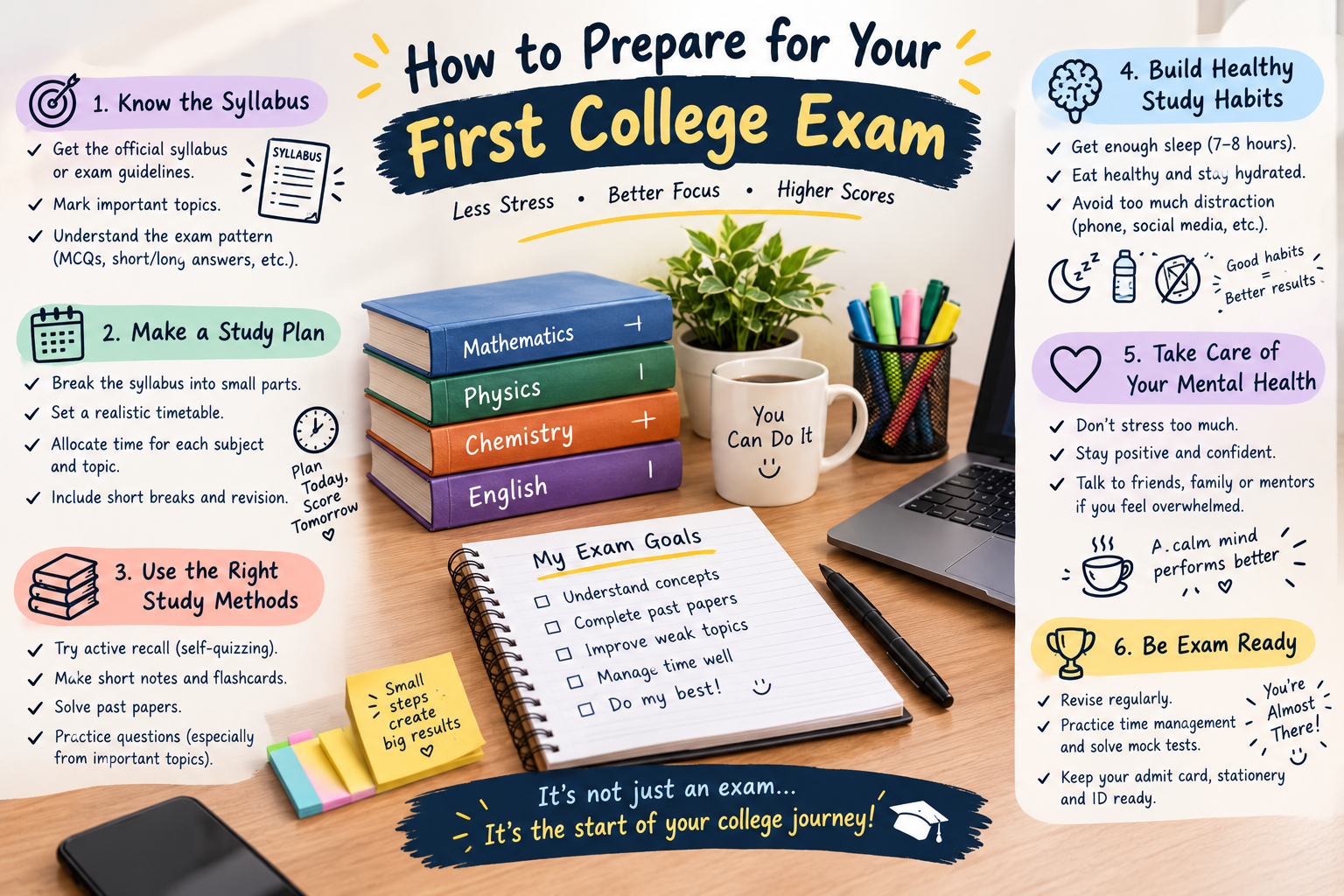
Your first college exam can feel very different from the tests you took in high school. College professors may expect you to understand concepts, apply information, explain ideas, and manage your own preparation. Study’s Point provides useful study material and practical information to help students develop better academic habits and feel more prepared for college life. With the right approach, preparing for your first exam does not have to become an overwhelming experience.
The key is to start early, understand what you need to study, organize your time, and practice recalling information instead of simply reading it again and again. A good preparation routine can also help you become more confident about future exams.
Understand What the Exam Covers
Before you start studying, find out exactly what material is included in the exam.
Check your syllabus, class notes, assignment instructions, textbook chapters, lecture slides, and any information provided by your professor.
Make a simple list of the topics you need to review.
For example:
- Chapter 1: Introduction
- Chapter 2: Key concepts
- Chapter 3: Important definitions
- Chapter 4: Applications
- Class discussion topics
- Previous homework questions
Knowing what you need to study prevents you from wasting time reviewing material that will not be part of the exam.
If your professor has provided an exam guide or review sheet, read it carefully. It can help you understand which topics deserve additional attention.
Start Studying Early
One of the most common mistakes students make is waiting until the night before an exam.
Cramming may give you time to look at a large amount of information, but it can also leave you tired and stressed.
Instead, begin preparing several days before the exam.
For example, if your exam is Friday, you could organize your week like this:
Monday: Review the first section.
Tuesday: Review the second section and practice questions.
Wednesday: Review difficult topics.
Thursday: Complete a full review and test yourself.
Friday: Do a short morning review if appropriate.
This type of exam preparation gives you multiple opportunities to return to the material.
Create a Simple Study Plan
You do not need a complicated timetable.
Write down the topics you need to cover and divide them across the available days.
For example:
| Day | Main Task |
| Monday | Review Chapter 1 |
| Tuesday | Review Chapter 2 |
| Wednesday | Review Chapter 3 |
| Thursday | Practice questions |
| Friday | Exam |
You can adjust the plan according to the difficulty of each topic.
If one chapter is much harder than another, give it more time.
A realistic college study plan should also include breaks. Studying continuously for several hours can become tiring, and your concentration may decline.
Review Your Class Notes
Your class notes can be one of your most useful study resources.
Go through your notes and identify the main ideas. Look for definitions, formulas, examples, important explanations, and topics your professor emphasized.
Do not simply read the notes from beginning to end.
Instead, stop after each section and ask yourself what you remember.
For example, after reading a page about an economic concept, close your notebook and explain the concept in your own words.
If you cannot explain it, return to the material and review it again.
This turns ordinary study notes into an active learning tool.
Use Active Recall
Active recall is a useful technique for first college exam preparation.
Instead of looking at the answer, try to remember it yourself.
You can use questions such as:
- What is the definition of this term?
- What are the main points of this topic?
- Why does this process happen?
- What example did the professor give?
- Can I explain this concept without looking at my notes?
You can also create flashcards.
Write the question on one side and the answer on the other. Then test yourself.
If you answer correctly, continue. If you struggle, mark the card and review it again later.
Practice With Questions
Reading can help you become familiar with a topic, but practice questions can show whether you actually understand it.
If your textbook includes questions at the end of each chapter, use them.
You can also create your own questions from your notes.
For example, instead of writing:
“Supply and demand affect prices.”
Create a question:
“How can changes in supply and demand affect prices?”
Then answer the question without looking at your notes.
This type of exam study techniques can help you identify areas where your understanding is weak.
Focus on Difficult Topics
It is tempting to spend most of your study time reviewing topics you already understand because they feel easier.
However, your limited study time may be more useful when you also focus on difficult areas.
Make a list of topics using three categories:
Green: I understand this.
Yellow: I understand some of it.
Red: I need more practice.
Start with the red topics.
Once you improve your understanding, move to the yellow topics.
This simple system can make your study sessions more organized.
Avoid Memorizing Everything
Some information does need to be memorized, such as vocabulary, formulas, dates, or specific facts.
However, college exams often require more than simple memorization.
A professor may ask you to apply a concept to a new situation.
For that reason, ask yourself:
“Why does this happen?”
“How does this work?”
“What would happen if something changed?”
“Can I give an example?”
“How is this concept different from another concept?”
Understanding the information can make it easier to remember and apply.
Use Spaced Review
Instead of studying a topic once and forgetting about it, return to it several times.
This is commonly called spaced repetition.
For example:
- Learn the topic on Monday.
- Review it on Tuesday.
- Test yourself again on Thursday.
- Review difficult points before the exam.
Each review does not have to take a long time.
A short review can be enough to remind yourself of the main information.
Take Breaks
Breaks are an important part of a sustainable study routine.
After a focused period of studying, step away for a few minutes.
You could:
- Drink water
- Walk around
- Stretch
- Have a light snack
- Rest your eyes
- Take a few deep breaths
Try not to turn a short break into a long social media session.
If you spend 10 minutes studying and 45 minutes scrolling through your phone, your study plan will quickly fall apart.
Reduce Distractions
Your environment can make studying easier or harder.
Before beginning a study session, remove unnecessary distractions.
Put your phone on silent or place it away from your desk.
Close unrelated browser tabs.
Choose a quiet place such as a library, study room, or calm area at home.
If you need your computer for studying, use it only for the tasks related to your exam.
Good college study tips are not only about what you study. They are also about creating conditions that help you concentrate.
Get Enough Sleep
Staying awake all night before an exam may seem like a way to gain extra study time, but it can leave you exhausted.
Try to prepare earlier so you can maintain a normal sleep schedule.
The night before your exam, organize your materials, check the exam time and location, and avoid unnecessary last-minute studying.
A calm evening can be more useful than trying to learn an entire course overnight.
Prepare Your Exam Materials
The day before your exam, make sure you know what you need.
Depending on your course, this could include:
- Student ID
- Pens or pencils
- Calculator
- Required notes
- Approved reference materials
- Water
- Laptop or charger if the exam is digital
Check your professor’s instructions so you know what is permitted.
This simple preparation can prevent unnecessary stress on exam day.
Do a Final Review
Your final review should not involve trying to learn everything from the beginning.
Instead, focus on:
- Important definitions
- Difficult concepts
- Formulas
- Key examples
- Mistakes from practice questions
- Topics you previously struggled with
If you have already studied throughout the week, the final review should mainly refresh your memory.
Manage Exam-Day Stress
Feeling nervous before your first college exam is normal.
Try to arrive with enough time to get settled.
Read the instructions carefully before starting.
If you encounter a difficult question, do not immediately panic. Move to another question if the exam format allows it and return later.
Use your time carefully.
Do not spend most of the exam on one question while leaving other questions unanswered.
Learn From Your First Exam
Your first college exam is also an opportunity to learn about yourself as a student.
After receiving your results, do not focus only on the grade.
Review your performance.
Ask yourself:
- Which topics did I understand?
- Which questions surprised me?
- Did I start studying early enough?
- Did my study method work?
- Did I spend too much time reading and not enough time practicing?
- Did I manage my exam time properly?
Your answers can help you improve your college exam preparation for the next test.
If you discover that rereading notes was not enough, try adding more practice questions or active recall next time.
Create a Routine for Future Exams
Once your first exam is finished, do not completely forget the system you developed.
Keep the parts that worked.
For your next exam, start by checking the syllabus and estimating how much material you need to cover.
Then create a study schedule and begin reviewing early.
Over time, exam preparation can become a normal part of your college routine instead of something you only think about when a deadline is close.
Final Thoughts
Preparing for your first college exam can feel challenging, especially when you are still learning how college classes work. The good news is that exam preparation is a skill that improves with practice.
Start early, understand the material, organize your notes, practice recalling information, and spend additional time on difficult topics. Take reasonable breaks, reduce distractions, get enough sleep, and prepare your materials before exam day.
Most importantly, remember that one exam does not define your entire college experience. Use every exam as an opportunity to understand what study methods work best for you.
With a consistent college study plan, practical exam study techniques, and regular review, you can approach your first college exam with a more organized and prepared mindset.
Disclaimer
The information provided in this article is for general educational and informational purposes only. It is not professional academic, financial, insurance, legal, medical, or career advice. Every student’s circumstances are different, and readers should consider their individual situation before making important decisions.
Information published on Study’s Point may change over time. Readers should verify important information with an appropriate qualified professional or official source when necessary.
Terms and Conditions
By using Study’s Point, visitors agree to use the website for lawful and personal informational purposes. Content published on the website is intended for general information and may be updated, changed, or removed without prior notice.
Study’s Point does not guarantee that all information will always be complete, current, or suitable for every individual. Website content should not be treated as a replacement for professional advice.
Visitors must not use the website for unlawful purposes, attempt to interfere with website operations, or reproduce substantial amounts of website content without appropriate permission.
Privacy Notice
Study’s Point may use cookies, analytics tools, and advertising technologies to understand website traffic, improve the website experience, and support website operations.
Third-party advertising and analytics providers may have their own privacy policies and terms. Visitors should review those policies when applicable.
Study’s Point does not require readers to provide unnecessary personal information when accessing educational content.
Contact
For questions, suggestions, corrections, or concerns regarding content published on Study’s Point, visitors can contact the website through its official contact channel.
Email: support@studyspoint.com
About Study’s Point
Study’s Point is an educational and informational website providing useful study material and practical information for students. The website focuses on clear and accessible content covering study techniques, academic preparation, and other useful educational subjects.
The information provided on Study’s Point is intended for general informational purposes and does not replace advice from qualified educators or other professionals.