
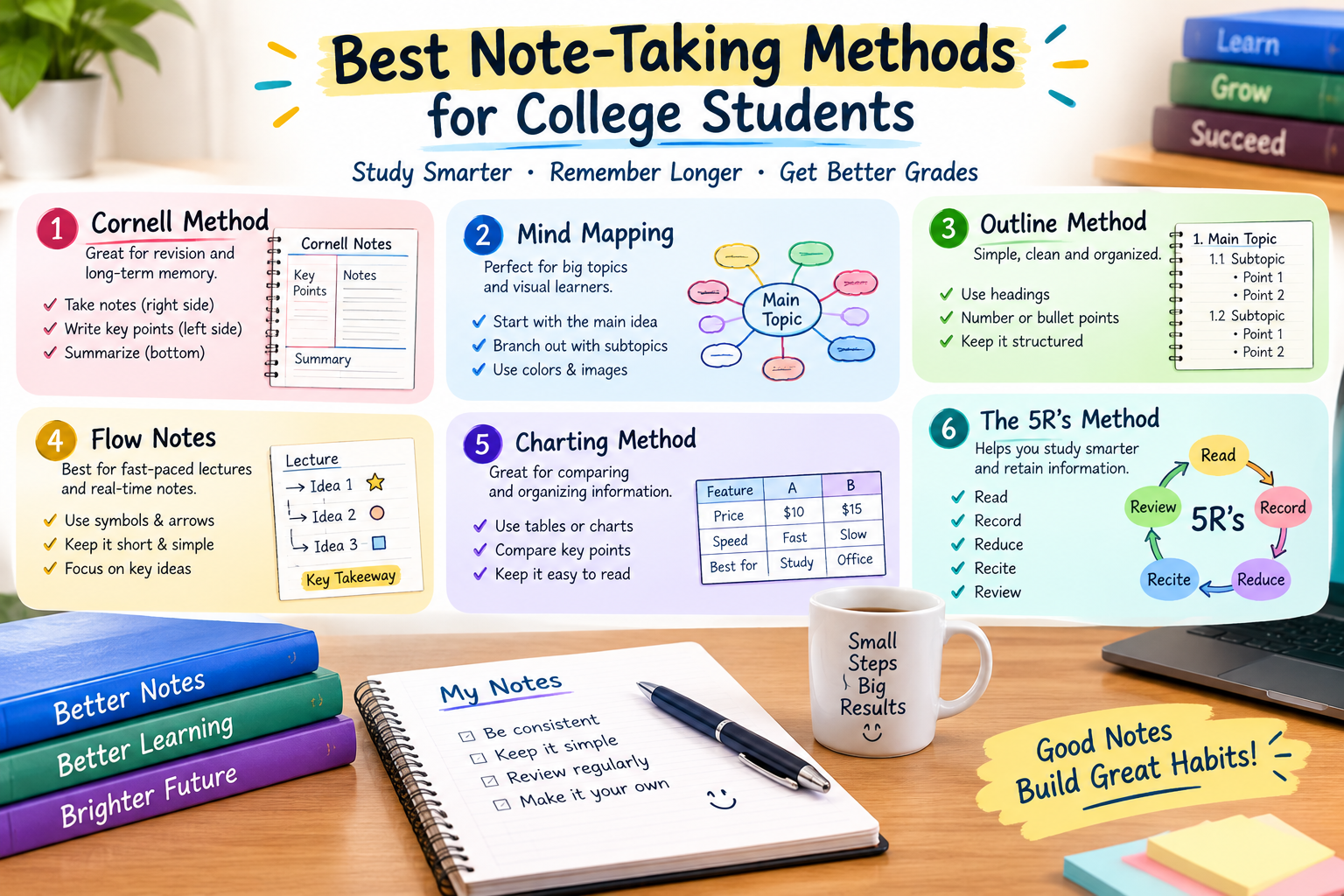
Taking good notes in college is more than simply writing down everything a professor says. The right notes can help you understand difficult subjects, review important information, prepare for exams, and remember lessons for longer. Study’s Point provides useful educational information and study material to help students develop practical academic habits. Learning how to take organized notes can make studying easier because you have a clear record of the important ideas discussed in class.
Every student has a different learning style, so there is no single note-taking method that works perfectly for everyone. Some students prefer writing by hand, while others find digital notes more convenient. The most useful approach is the one that helps you understand information and find it again when you need it.
Why Good Note-Taking Matters in College
College classes can move quickly. A professor may explain several concepts during one lecture, provide examples, answer questions, and introduce information that may later appear on an exam.
Trying to remember everything without taking notes can become difficult.
Good notes give you something to return to after class. Instead of starting from the beginning of a textbook every time you need to review a topic, you can look at your class notes and identify the main points.
Good notes can also help you:
- Review lessons before exams
- Remember important definitions
- Organize complicated subjects
- Identify topics that need more practice
- Create study questions
- Prepare assignments and projects
- Track important examples and explanations
The goal is not to produce the longest notes. The goal is to create useful notes.
1. The Cornell Note-Taking Method
The Cornell method is one of the most recognized note-taking methods for students.
The page is divided into three main areas:
- A large section for class notes
- A smaller cue column for questions or keywords
- A summary section at the bottom
During class, write the main information in the large notes section. After class, use the cue column to add questions or important terms.
At the bottom of the page, write a short summary of the lesson.
For example, if your biology lecture is about cell division, your notes might contain important stages and explanations. The cue column could include questions such as “What happens during metaphase?” Your summary could explain the overall process in a few sentences.
This method is useful because it turns your notes into a study resource instead of just a record of the lecture.
2. The Outline Method
The outline method works well when a lecture has a clear structure.
Start with the main topic and then create smaller points underneath it.
For example:
Photosynthesis
- Definition
- Process used by plants
- Main requirements
- Sunlight
- Water
- Carbon dioxide
- Main products
- Glucose
- Oxygen
- Important stages
- Light-dependent reactions
- Calvin cycle
This structure makes relationships between ideas easier to see.
The outline method can be particularly useful for history, business, science, psychology, and other subjects where information is presented in categories.
3. The Mapping Method
The mapping method uses visual connections between ideas.
Write the main topic in the center of your page. Then add related concepts around it and connect them using lines or arrows.
For example, if the main topic is “The U.S. Constitution,” you might connect it to:
- Constitutional principles
- Branches of government
- Amendments
- Federalism
- Individual rights
You can then add smaller details beneath each area.
This is a useful form of visual note-taking because it shows how different concepts relate to one another.
Students who prefer diagrams and visual organization may find this method easier than writing long paragraphs.
4. The Charting Method
The charting method organizes information into columns.
It can be especially helpful when you need to compare different subjects.
For example, if you are studying economic systems, your notes might include columns for:
| Economic System | Main Features | Advantages | Challenges |
| Capitalism | Private ownership | Competition | Inequality concerns |
| Socialism | Greater public role | Social programs | Government involvement |
| Mixed Economy | Combination of systems | Flexibility | Complex regulation |
The same approach can be used for history, science, literature, business, and many other subjects.
Whenever your professor compares two or more concepts, a chart can make the differences easier to review.
5. The Sentence Method
The sentence method involves writing important information as individual sentences or short points.
For example:
- The Federal Reserve is the central banking system of the United States.
- Monetary policy can influence interest rates.
- Higher interest rates can affect borrowing.
- The Federal Reserve uses several tools to influence monetary conditions.
This method can be useful when a lecture moves quickly and you do not have enough time to organize everything immediately.
However, avoid writing every sentence word-for-word. Try to capture the main idea using your own words whenever possible.
6. Take Notes in Your Own Words
One of the most important college note-taking tips is to avoid copying everything exactly.
When you rewrite an idea in your own words, you have to think about what the information actually means.
Instead of copying a long definition, write a shorter explanation that you understand.
For example:
Original idea:
“Photosynthesis is the process through which green plants convert light energy into chemical energy.”
Your note could say:
“Photosynthesis = plants use light energy to make chemical energy.”
Your version should still be accurate, but it can be shorter and easier to remember.
7. Highlight Important Information Carefully
Highlighting can be helpful, but highlighting almost everything defeats the purpose.
Try to highlight only information that is especially important.
Useful things to mark include:
- Key definitions
- Formulas
- Dates
- Important names
- Main arguments
- Exam-related information
- Concepts you do not understand
If every sentence has the same level of emphasis, it becomes difficult to know what deserves attention.
A simple system can work well. For example, you might use one symbol for important information and another for questions you need to research later.
8. Combine Handwritten and Digital Notes
Some students prefer notebooks, while others prefer laptops or tablets.
Both approaches can work.
Handwritten notes can encourage you to summarize information rather than copying large amounts of text. Digital notes can be easier to organize, search, edit, and back up.
You can also combine both methods.
For example, take quick handwritten notes during a lecture and create a cleaner digital summary afterward.
The best digital note-taking system is not necessarily the one with the most features. It is the one that helps you organize and review information without creating extra work.
9. Review Your Notes After Class
Taking notes is only the first step.
Try to review your notes soon after class. Even 10 to 15 minutes can be useful.
During your review:
- Correct unclear information.
- Add missing details.
- Circle important concepts.
- Write questions beside confusing topics.
- Create a short summary.
- Identify information that needs further practice.
This process can turn rough class notes into a useful study resource.
If you wait until the night before an exam to look at your notes for the first time, you may discover that some sections are confusing or incomplete.
10. Turn Notes Into Questions
One of the easiest ways to improve study notes for exams is to turn information into questions.
Instead of writing:
“Three branches of the U.S. government: legislative, executive, judicial.”
Create questions such as:
“What are the three branches of the U.S. government?”
“What is the main function of the legislative branch?”
“What does the executive branch do?”
“What role does the judicial branch play?”
You can then cover the answers and test yourself.
This transforms passive notes into active study material.
11. Use Abbreviations and Symbols
You do not have to write every word during a fast lecture.
Develop a small system of abbreviations and symbols.
For example:
- “w/” = with
- “b/c” = because
- “ex.” = example
- “→” = leads to
- “↑” = increase
- “↓” = decrease
- “?” = unclear
- “*” = important
The purpose is to save time.
However, make sure your abbreviations are easy for you to understand later. A system that saves time during class but makes your notes confusing afterward is not helpful.
12. Leave Space for Additional Information
Do not fill every part of the page.
Leave some empty space between topics or near the side of your notes.
You can later use that space to add:
- Examples
- Definitions
- Questions
- Corrections
- Extra explanations
- Information from your textbook
This is especially useful because professors sometimes explain a topic differently after the initial lecture.
13. Identify What Your Professor Emphasizes
Pay attention when your professor says something like:
“This is important.”
“You should remember this.”
“This will be on the exam.”
“Make sure you understand this concept.”
These statements can indicate information that deserves special attention.
However, do not assume that only information mentioned as “important” will appear on an exam. Continue studying the broader course material and follow your professor’s official instructions.
14. Keep Your Notes Organized
Good organization can save a surprising amount of time.
Use a consistent system for:
- Course names
- Dates
- Lecture titles
- Chapters
- Assignments
- Exam reviews
If you use digital notes, create folders for individual courses.
If you use notebooks, consider giving each course a separate section.
Organized notes make academic organization easier because you can quickly locate the material you need.
15. Avoid Distractions While Taking Notes
A laptop can be useful for note-taking, but it can also provide easy access to social media, videos, games, and unrelated websites.
If you are using a computer during class, keep only the applications you need open.
Turn off unnecessary notifications.
If possible, put your phone on silent and keep it away from your immediate workspace.
The goal is to keep your attention on the lecture.
How to Choose the Right Note-Taking Method
You do not have to choose only one method.
Different courses may require different approaches.
For example:
- Use the Cornell method for lectures with many important concepts.
- Use the outline method for structured lectures.
- Use mapping for connected ideas.
- Use charts for comparisons.
- Use sentence notes for fast-moving lectures.
Experiment with different systems for a few weeks.
Ask yourself:
“Can I understand these notes later?”
“Can I find important information quickly?”
“Do these notes help me prepare for exams?”
“Am I spending too much time writing instead of listening?”
The answers can help you determine which approach works best.
Final Thoughts
Effective note-taking is a skill that improves with practice. College students do not need to create perfect notes during every lecture. The goal is to capture important information in a form that makes sense later.
Try different note-taking methods, organize your material, review your notes regularly, and turn important information into questions. Most importantly, focus on understanding rather than simply copying.
Whether you prefer handwritten notebooks, a laptop, a tablet, outlines, charts, or visual maps, choose a system that supports your learning style and academic goals.
Good notes can become one of your most valuable study resources throughout the semester. With a consistent approach and regular review, students can make their study sessions more focused and productive.
Disclaimer
The information provided in this article is for general educational and informational purposes only. It is not professional academic, financial, insurance, legal, medical, or career advice. Individual circumstances can vary, and readers should consider their own situation before making important decisions.
Information published on Study’s Point may change over time. Readers should verify important information with an appropriate qualified professional or official source when necessary.
Terms and Conditions
By using Study’s Point, visitors agree to use the website for lawful and personal informational purposes. The content published on the website is provided for general information and may be updated, changed, or removed without prior notice.
Study’s Point does not guarantee that all information will always be complete, current, or suitable for every reader. Users should not rely on general website content as a substitute for professional advice.
Visitors must not use the website for unlawful activities, attempt to interfere with its operation, or reproduce substantial amounts of website content without appropriate permission.
Privacy Notice
Study’s Point may use cookies, analytics services, and advertising technologies to understand website traffic, improve the user experience, and support the operation of the website.
Third-party services used on the website may have their own privacy policies and terms. Visitors should review those policies when applicable.
Study’s Point does not require readers to provide unnecessary personal information when reading educational content.
Contact
For questions, suggestions, corrections, or concerns about content published on Study’s Point, visitors can contact the website through its official contact channel.
Email: support@studyspoint.com
About Study’s Point
Study’s Point is an educational and informational website created to provide useful study material and practical information for students. The website focuses on accessible articles that can help students understand academic topics, study techniques, and other useful educational subjects.
The content is intended for general informational purposes and does not replace professional advice from qualified educators or other professionals.