
Starting college can introduce students to many terms that they may not have heard before. One of the most important is the college credit. Understanding credits can help students plan their classes, track their degree progress, and understand what they need to complete before graduation. Study’s Point provides educational resources that help college students understand academic requirements and make informed decisions about their studies. Whether you are a first-year student or preparing for graduation, knowing how college credits work can make academic planning much easier.
What Is a College Credit?
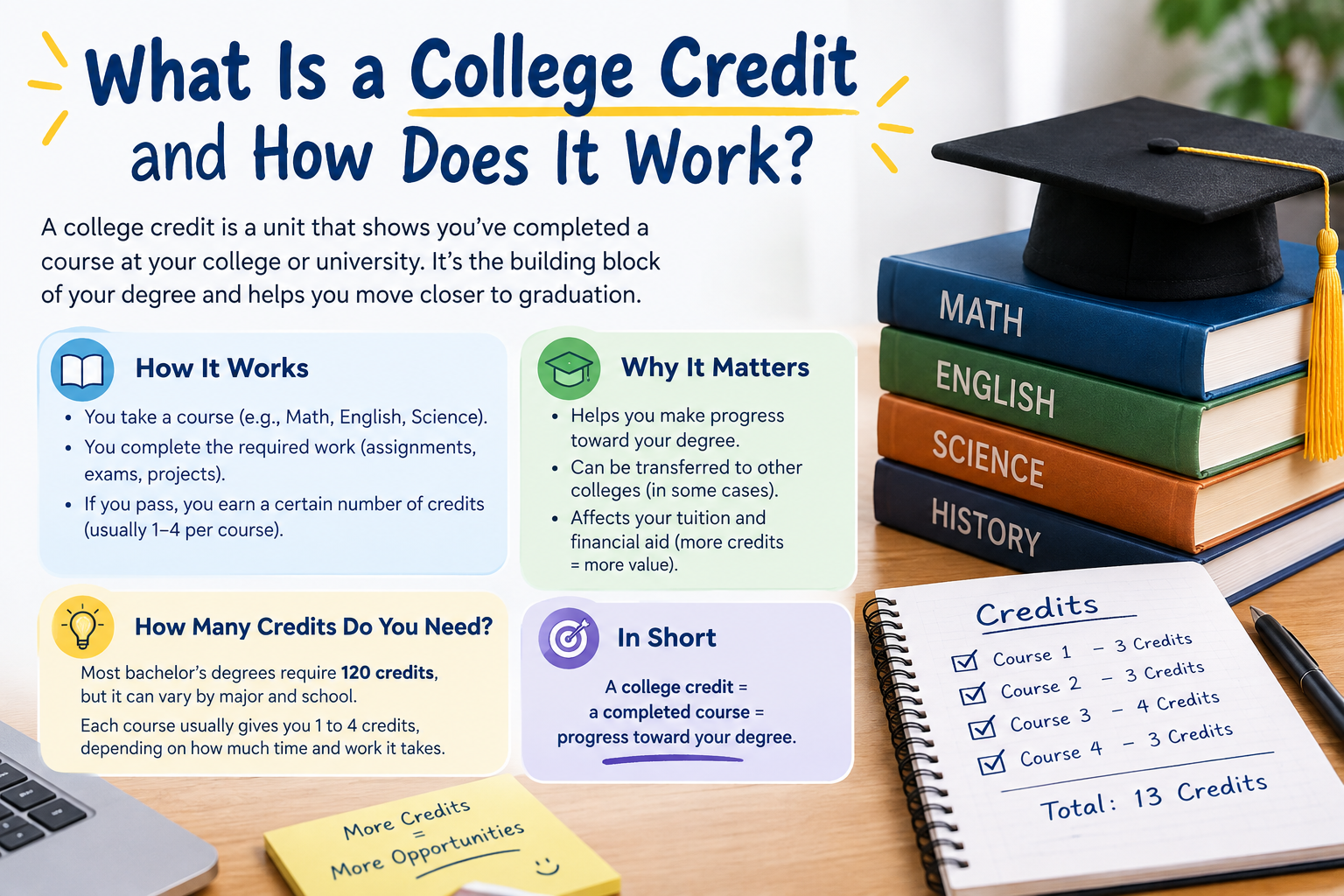
A college credit is a unit used by colleges and universities to measure academic coursework.
When you successfully complete a college course, you usually earn a certain number of credits. The number of credits depends on the course and the institution.
For example, a typical undergraduate course may be worth three credits. Some courses may be worth one, two, four, or more credits.
Credits help colleges measure how much coursework a student has completed toward a degree.
Instead of simply saying that a student completed ten classes, colleges can use credits to track the amount and type of academic work completed.
How Do College Credits Work?
When you register for a college course, the course usually has a specific credit value.
For example:
- English Composition — 3 credits
- Introduction to Psychology — 3 credits
- College Mathematics — 3 credits
- Biology with Laboratory — 4 credits
If you successfully complete all four courses, you would earn 13 credits.
These credits are then added to your academic record and can count toward your degree requirements, depending on the program.
This is why understanding college credits is important when planning your academic schedule.
How Many Credits Is a Full-Time College Student?
The number of credits considered full-time can vary by institution and program.
At many U.S. colleges, undergraduate students taking around 12 or more credits during a regular semester are considered full-time for enrollment purposes.
However, students should check their own college’s rules because requirements can differ.
Some students may take more than 12 credits in a semester, while others may take fewer because of work, family responsibilities, academic needs, or other circumstances.
Being a full-time student and completing a degree on time are related but are not exactly the same thing.
How Many Credits Do You Need for a Bachelor’s Degree?
Many bachelor’s degree programs in the United States require approximately 120 semester credits for graduation.
However, the exact requirement can vary depending on the college, major, and degree program.
For example, one university may require 120 credits while another program may require more.
Students should always check their official degree requirements rather than assuming that every bachelor’s degree has the same credit requirement.
What Are Credit Hours?
The terms “credit” and “credit hour” are often used when discussing college courses.
A credit hour is generally connected to the amount of academic instruction and work expected from a course.
For example, a three-credit course usually represents a larger academic commitment than a one-credit course.
The exact way institutions define credit hours can vary, especially between traditional classes, laboratory courses, internships, clinical experiences, and other types of academic activities.
Semester Credits vs. Quarter Credits
Not every college uses the same academic calendar.
Many U.S. colleges use semesters, while some use quarters.
A semester system usually divides the academic year into longer terms. A quarter system divides the academic year into shorter terms.
Because the systems use different credit structures, a quarter credit is not always equal to a semester credit.
Students transferring between schools should ask how their credits will be converted.
This is especially important when planning a college degree plan.
What Is a Degree Requirement?
A degree requirement is a course, credit, subject area, or other academic requirement that students must complete to graduate.
A bachelor’s degree may include several categories of requirements.
These can include:
- General education courses
- Major requirements
- Minor requirements
- Elective courses
- Laboratory requirements
- Writing requirements
- Mathematics requirements
- Other program-specific requirements
Completing enough total credits does not necessarily mean that a student has completed all degree requirements.
This is one of the most important things new college students should understand.
Why Total Credits Are Not Enough
Imagine that a degree requires 120 credits.
A student might complete 120 credits but still be missing an important required course for their major.
For example, suppose a student has:
- 120 total credits
- Most general education requirements completed
- Several elective courses completed
- One required major course missing
The student may still need to complete that required course before graduating.
This is why students should monitor both their total credits and their individual degree requirements.
General Education Credits
Many colleges require students to complete general education courses.
These classes are designed to provide a broad academic foundation.
General education requirements may include areas such as:
- English composition
- Mathematics
- Natural sciences
- Social sciences
- Humanities
- Communication
The exact requirements depend on the institution and degree program.
General education courses can also help students explore subjects outside their major.
Major Credits
Your major is the primary area of study for your degree.
Major courses usually make up an important portion of your total credits.
For example, a student majoring in biology may need courses in:
- Biology
- Chemistry
- Genetics
- Cell biology
- Laboratory science
- Other specialized subjects
A student majoring in business may have requirements in areas such as:
- Accounting
- Economics
- Marketing
- Finance
- Management
The number and type of major credits depend on the specific program.
Elective Credits
Electives are courses that students can choose based on their degree requirements and interests.
Some degree programs provide students with considerable flexibility in choosing electives.
For example, a student may choose an elective in:
- Psychology
- Art
- Computer science
- Communication
- History
- Foreign language
Electives can allow students to explore subjects that are not directly part of their major.
However, not every elective will necessarily count toward every degree requirement, so students should check their academic plan before registering.
What Happens When You Pass a Course?
When you successfully complete a college course, the credits associated with that course are generally added to your academic record.
For example, if you complete a three-credit course successfully, those three credits can become part of your completed coursework.
Your grade may also affect your GPA.
Credits and grades are related to your academic record, but they represent different things.
Credits measure completed academic coursework, while grades show how you performed in that coursework.
What Happens If You Fail a Course?
If you fail a course, the situation can depend on the college’s academic policies.
In many cases, a failed course does not provide the credits needed for degree completion.
However, the grade may still affect your GPA.
Students may have the option to retake the course, depending on school policies.
When retaking a course, it is important to understand how the college handles the original and repeated grades.
Students should contact an academic advisor or registrar’s office for information specific to their institution.
Do AP and IB Courses Give College Credit?
Some colleges may award college credit for certain Advanced Placement (AP), International Baccalaureate (IB), or other approved programs.
The amount of credit can depend on:
- The exam or course
- The score received
- The college’s policy
- The student’s degree program
For example, a student may receive credit for an introductory course after earning a qualifying AP exam score.
However, policies differ significantly between colleges.
Students should check the institution’s official credit policies before assuming that an exam will replace a college course.
Can You Transfer College Credits?
College credits can sometimes be transferred from one institution to another.
However, transfer policies vary.
A college may accept a course for:
- Direct degree credit
- General education credit
- Elective credit
- Major credit
In some cases, a college may accept the credits but not apply them toward a specific requirement.
This distinction is important for students planning to transfer.
What Is Credit Transfer?
Transfer credits are previously completed academic credits that another college or university accepts toward a student’s new program.
For example, a student might complete two years at a community college and then transfer to a four-year university.
Some of the completed credits may count toward the bachelor’s degree.
The number of accepted credits depends on factors such as course content, grades, accreditation, institutional agreements, and the receiving college’s policies.
Community College Credits
Community colleges can provide an affordable pathway for students who plan to continue toward a bachelor’s degree.
Many students complete general education courses at a community college before transferring to a four-year institution.
However, students should plan carefully.
Before taking classes with the intention of transferring them, check whether the receiving university will accept those courses.
A transfer agreement between institutions can sometimes make the process easier.
How Credits Affect Graduation
Credits are one of the main ways colleges track progress toward graduation.
Suppose a bachelor’s program requires 120 credits.
A student might complete:
- First year: 30 credits
- Second year: 30 credits
- Third year: 30 credits
- Fourth year: 30 credits
That equals 120 credits.
However, students do not always complete exactly 30 credits every year.
Some students take fewer credits during one semester and more during another. Others may take summer courses.
The important thing is to meet the requirements of the degree program.
Can You Graduate With More Than the Required Credits?
Yes, some students graduate with more credits than their program requires.
This can happen when students change majors, take electives, repeat courses, add a minor, transfer between programs, or explore additional subjects.
Having extra credits does not automatically mean something is wrong.
However, additional courses may increase tuition costs and time spent in college, so students should understand how extra coursework fits into their academic goals.
How to Track Your College Credits
Students should regularly monitor their academic progress.
Most colleges provide tools such as:
- Degree audits
- Student portals
- Academic planning systems
- Unofficial transcripts
- Advising reports
A degree audit can show which requirements you have completed and which ones remain.
Reviewing this information regularly can help prevent surprises near graduation.
Talk to an Academic Advisor
An academic advisor can help you understand your degree requirements and plan future courses.
If you are unsure whether a course will count toward your degree, ask before registering.
You can also discuss:
- Transfer credits
- Course sequencing
- Graduation requirements
- Major requirements
- Electives
- Summer classes
- Changing majors
- Minors
Good academic planning can help students avoid taking unnecessary courses.
Common Mistakes Students Make With Credits
Students sometimes make mistakes because they focus only on the total number of credits.
Common mistakes include:
- Assuming every course counts toward the major
- Ignoring required prerequisites
- Not checking transfer policies
- Taking unnecessary electives
- Waiting until senior year to check degree requirements
- Assuming AP or IB credit works the same at every college
- Forgetting about minimum grade requirements
Checking your degree audit and speaking with an advisor can help reduce these problems.
Final Thoughts
College credits are a basic but important part of understanding how higher education works. Credits help colleges measure completed coursework and help students track progress toward their degrees.
However, students should remember that earning a certain number of credits is only one part of graduation. You also need to complete the specific requirements of your program, including general education courses, major courses, and any other required components.
If you understand how credits work from the beginning, you can make better decisions about course selection, transfer planning, and your path toward graduation. Keep track of your completed credits, review your degree requirements regularly, and ask your academic advisor whenever you are unsure about a course.
Disclaimer
The information provided by Study’s Point is for general educational and informational purposes only. College credit systems, degree requirements, transfer policies, and enrollment rules can vary by institution and program. Students should check their college’s official academic policies and consult an academic advisor for guidance related to their individual situation.
Terms & Conditions
By using Study’s Point, you agree to use the information provided on this website for lawful and informational purposes. Content may be updated or changed without prior notice. Study’s Point does not guarantee specific academic, financial, career, or educational outcomes from using information available on the website.
Privacy Notice
Study’s Point respects visitor privacy. Information collected through the website is handled according to applicable website privacy practices. Visitors should review the Privacy Notice for information about data collection, cookies, advertising technologies, and website usage.
Contact Study’s Point
For questions, suggestions, or general inquiries, contact Study’s Point at support@studyspoint.com.
About Study’s Point
Study’s Point is an educational website providing study materials, academic information, and practical resources for students. Our goal is to make useful educational information easier for students to understand and apply.