
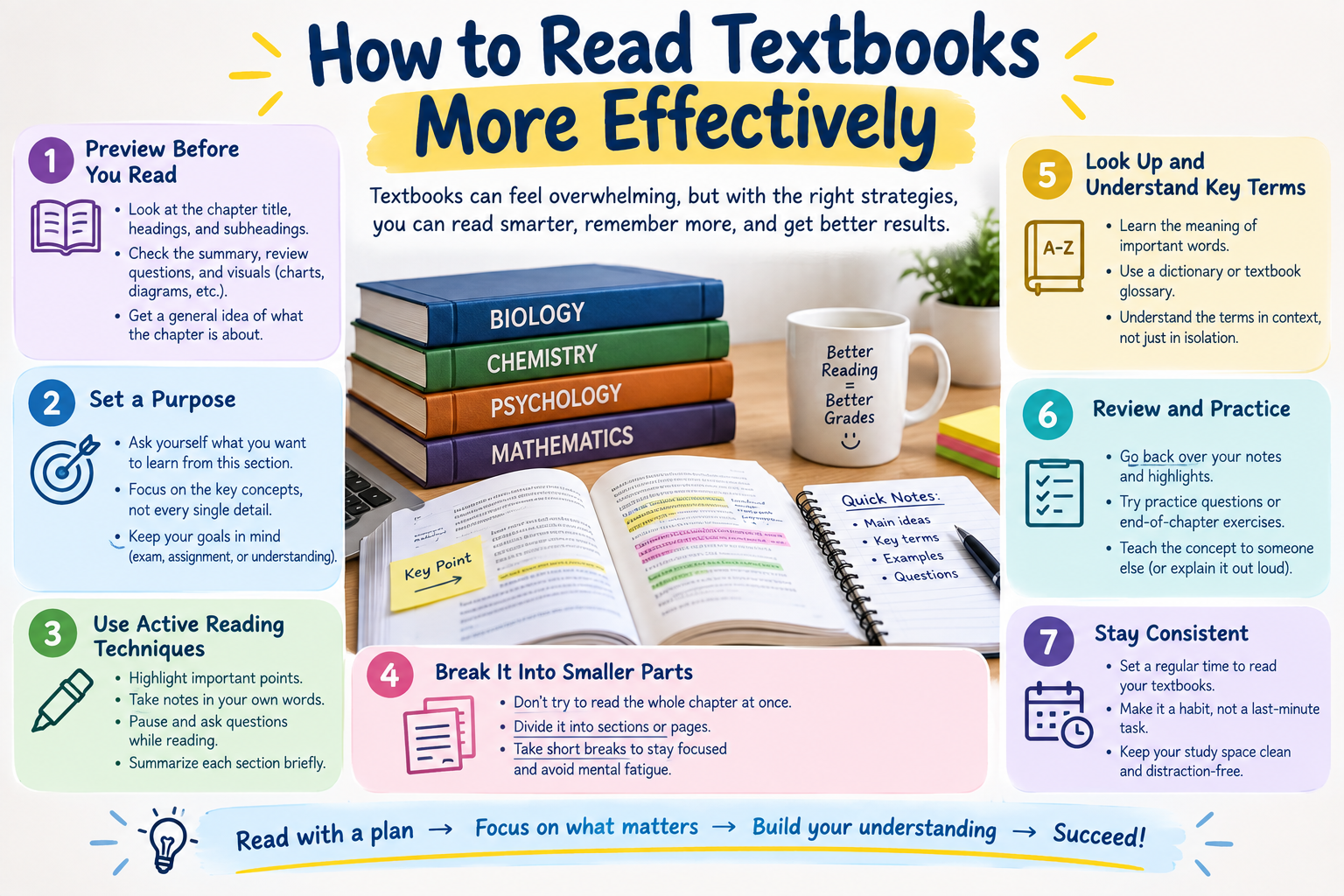
ge textbooks can contain a large amount of information, and reading them can sometimes feel difficult or time-consuming. Students may spend hours reading pages without remembering much afterward. The problem is often not the amount of reading but the way the material is approached. Study’s Point provides practical educational resources to help students develop better study habits, improve learning strategies, and become more organized in college. Learning how to read textbooks effectively can help you understand difficult subjects, remember important information, and prepare more confidently for assignments and exams.
Why Textbook Reading Matters in College
Textbooks are often used to introduce concepts, explain important theories, provide examples, and support classroom learnin
Professors may expect students to read textbook chapters before or after lectures.
However, college textbook reading is different from casually reading a novel.
You need to identify important ideas, understand unfamiliar concepts, connect information, and remember material that may later appear on an exam.
This is why simply reading every word from beginning to end may not always be the most effective approach.
Preview the Chapter Before Reading
Before starting a chapter, spend a few minutes looking over the material.
Check:
- Chapter title
- Headings
- Subheadings
- Bold terms
- Charts
- Tables
- Diagrams
- Review questions
- Chapter summary
This gives you an overview of what you are about to study.
A quick preview can also help you identify the main topics before you begin reading the details.
Read With a Purpose
One of the most useful textbook reading strategies is to know why you are reading.
Before starting, ask:
“What do I need to learn from this chapter?”
You might be reading to:
- Understand a new concept
- Prepare for a quiz
- Complete an assignment
- Review lecture material
- Prepare for an exam
- Learn important vocabulary
Having a purpose helps you focus on information that matters.
Turn Headings Into Questions
Instead of simply reading headings, turn them into questions.
For example, if a heading says:
“Causes of the American Civil War”
turn it into:
“What were the major causes of the American Civil War?”
Then read the section looking for the answer.
This simple technique encourages active reading because your brain is searching for specific information.
Use Active Reading
Active reading means interacting with the material instead of allowing your eyes to move across the page without thinking about the content.
During active textbook reading, you can:
- Ask questions
- Take short notes
- Highlight key information
- Summarize sections
- Identify important terms
- Connect new ideas to previous knowledge
The goal is to think about the information while reading.
Do Not Highlight Everything
Highlighting can be useful, but highlighting too much can reduce its value.
If almost every sentence is highlighted, it becomes difficult to identify what is actually important.
Instead, focus on:
- Main ideas
- Important definitions
- Key dates
- Major concepts
- Important formulas
- Supporting facts
- Information your professor emphasizes
Try to keep highlighting limited and purposeful.
Write Short Notes
Writing short notes can help you process what you are reading.
You do not need to rewrite the entire textbook.
Instead, write brief notes such as:
“Main cause = economic pressure”
or:
“Three stages of process”
The purpose is to capture important information in a form that is easy to review later.
Summarize Each Section
After completing a section, stop for a moment and summarize what you just learned.
Try explaining the main idea in two or three sentences without looking at the textbook.
If you cannot explain it, go back and review the section.
This is an effective form of textbook comprehension because it tests whether you actually understand the material.
Use the Question-and-Answer Method
Another useful approach is to create questions while reading.
For example:
Question: What is photosynthesis?
Answer: It is the process through which plants convert light energy into chemical energy.
You can later use these questions to review the chapter.
This turns your textbook into a study resource rather than something you read only once.
Connect Textbook Material With Lectures
If your professor discusses a concept in class that also appears in the textbook, connect the two.
Your lecture notes may explain the topic in a simpler way, while the textbook may provide more detail.
For example:
- Textbook: Detailed explanation
- Lecture: Professor’s explanation
- Notes: Your understanding
- Practice questions: Application
Connecting these sources can create a stronger understanding of the subject.
Pay Attention to Examples
Textbooks often include examples to explain difficult concepts.
Do not skip examples simply because they seem less important than definitions.
Examples can show you how a concept works in a real situation.
For subjects such as mathematics, science, economics, accounting, and statistics, examples can be particularly helpful.
After reading an example, try solving a similar problem yourself.
Do Not Read Every Chapter at the Same Speed
Not every section deserves the same amount of time.
Some pages may introduce basic information that you already understand.
Other sections may contain difficult concepts that require more attention.
Adjust your reading speed accordingly.
Spend more time on unfamiliar material and move more quickly through information you already understand.
Take Breaks During Long Reading Sessions
Long textbook chapters can become mentally tiring.
If you have a large amount of reading, divide it into smaller sessions.
For example:
- Read for 30–45 minutes.
- Take a short break.
- Return to the next section.
- Review your notes.
Short breaks can help you maintain concentration.
Use the Pomodoro Technique
The Pomodoro technique is one possible way to organize reading time.
A simple version is:
- 25 minutes reading
- 5 minutes break
- 25 minutes reading
- 5 minutes break
- Longer break after several sessions
You can adjust the timing according to your needs.
Some students prefer longer sessions, such as 45 or 50 minutes, followed by a short break.
The goal is to maintain focused reading rather than force yourself to use one exact schedule.
Remove Distractions
Textbook reading requires concentration.
Before starting, try to reduce distractions.
You can:
- Put your phone on silent.
- Turn off unnecessary notifications.
- Close unrelated browser tabs.
- Use a quiet study area.
- Keep only necessary materials nearby.
If you are studying digitally, consider using full-screen reading mode when appropriate.
Choose the Right Reading Environment
Your environment can influence your ability to concentrate.
Some students prefer:
- Libraries
- Quiet study rooms
- Dorm rooms
- Home desks
- Campus study areas
- Coffee shops with limited distractions
Try different environments and identify where you can focus most effectively.
Read Difficult Material Twice
Sometimes a difficult paragraph will not make sense the first time.
That is normal.
Instead of immediately giving up, read it again more slowly.
Look for:
- Definitions
- Examples
- Key terms
- Connections with earlier sections
If the concept is still unclear, use your lecture notes or ask your professor for clarification.
Use the Feynman Technique
The Feynman technique is based on explaining a concept in simple language.
After reading a difficult topic, imagine that you need to explain it to someone who has never studied it.
Try to explain it without using complicated textbook language.
If you cannot explain it clearly, identify the part you do not understand and review it.
This technique can improve deep learning because it encourages you to understand ideas rather than simply memorize sentences.
Use Diagrams and Visuals
Some textbook topics are easier to understand visually.
If the textbook contains:
- Diagrams
- Flowcharts
- Maps
- Graphs
- Tables
- Timelines
Spend time studying them.
You can also create your own simple diagram if it helps you understand how different ideas connect.
Learn Important Vocabulary
Many college subjects contain specialized vocabulary.
When you encounter an unfamiliar term:
- Read the definition.
- Look at the example.
- Write the term in your own words.
- Use it in a sentence.
- Review it later.
Understanding vocabulary can make the rest of the chapter easier to understand.
Use Active Recall After Reading
Reading alone does not guarantee that you will remember the information.
After finishing a section, close the book and ask yourself what you remember.
Try answering questions such as:
- What was the main idea?
- What were the most important details?
- What terms did I learn?
- How does this concept connect to the previous topic?
- Could I explain this to another student?
This is called active recall, and it can be a useful way to strengthen your memory.
Review Textbook Material More Than Once
Do not wait until the night before an exam to open the textbook again.
A better approach is to review information periodically.
For example:
First review: Immediately after reading
Second review: A few days later
Third review: Before the exam
This approach can make exam preparation less stressful.
Combine Reading With Practice
For many subjects, reading should be followed by application.
For example:
- Mathematics → solve problems
- Biology → answer practice questions
- History → explain causes and effects
- Economics → work through examples
- Psychology → apply concepts to situations
- Accounting → complete practice problems
Using information is often more useful than simply rereading it.
Know When to Ask for Help
If you have read a section several times and still do not understand it, ask for help.
Possible resources include:
- Professor office hours
- Teaching assistants
- Academic tutoring
- Writing or learning centers
- Study groups
- Classmates
Asking questions early can prevent confusion from building throughout the semester.
Avoid Last-Minute Textbook Reading
Trying to read several chapters the night before an exam can be overwhelming.
Instead, check your syllabus and plan reading throughout the week.
For example, if your professor assigns one chapter per week, divide the reading across several days.
This creates a manageable college reading routine.
Create a Textbook Reading Schedule
A simple weekly schedule might look like this:
Monday
Read the first section and take short notes.
Tuesday
Read the second section and review Monday’s material.
Wednesday
Read the third section and answer questions.
Thursday
Finish the chapter and summarize the main ideas.
Friday
Review important terms and practice questions.
Weekend
Complete a short review of the entire chapter.
This approach prevents a large reading assignment from becoming a last-minute problem.
Keep Your Notes Organized
If your textbook notes are scattered across different notebooks, apps, and documents, reviewing them later can become difficult.
Choose one system and keep it organized.
You can use:
- A dedicated notebook
- Digital documents
- Course folders
- Note-taking apps
- Printed study sheets
Include the course name, chapter, date, and topic so you can find information quickly.
Do Not Depend Only on Rereading
Rereading is sometimes useful, but it should not be your only study method.
Instead, combine reading with:
- Self-testing
- Summarizing
- Practice questions
- Flashcards
- Teaching concepts
- Writing explanations
- Reviewing notes
This creates a more active learning process.
How to Know If You Actually Understand the Chapter
After finishing a chapter, ask yourself:
Can I explain the main idea without looking at the textbook?
Can I define the important terms?
Can I answer basic questions about the chapter?
Can I connect the information to something I learned previously?
Can I solve or apply a related problem?
If you can answer these questions confidently, you probably have a stronger understanding of the material.
If not, identify the weak areas and review them.
Final Thoughts
Learning how to read textbooks more effectively can make college studying easier and more productive. The goal is not to read every page as quickly as possible. Instead, focus on understanding important ideas, connecting information, asking questions, and remembering what you learn.
Preview chapters before reading, create questions from headings, take short notes, summarize sections, and use active recall after reading. Combine textbook reading with lectures, practice questions, and regular review.
Most importantly, give yourself enough time. Strong college reading skills develop through practice. Once you discover the reading techniques that work best for you, textbook assignments can become more manageable and useful for your overall academic success.
Disclaimer
The information provided by Study’s Point is intended for general educational and informational purposes only. Study strategies may work differently for different students, courses, and learning environments. Students should follow their instructors’ specific requirements and seek appropriate academic support when needed.
Terms & Conditions
By using Study’s Point, you agree to use the information provided on this website for lawful and informational purposes. Content may be updated or changed without prior notice. Study’s Point does not guarantee specific academic, educational, career, financial, or other outcomes from using the information available on the website.
Privacy Notice
Study’s Point respects visitor privacy. Information collected through the website is handled according to applicable privacy practices. Visitors should review the Privacy Notice for additional information about data collection, cookies, advertising technologies, and website usage.
Contact Study’s Point
For questions, suggestions, or general inquiries, contact Study’s Point at support@studyspoint.com.
About Study’s Point
Study’s Point is an educational website providing study materials, academic information, and practical resources for students. Our goal is to make useful educational information easier to understand and apply in everyday student life.